E-commerce fulfillment
Volatile SKU depth and compressed carrier windows. Fast staging with documented buffer occupancy.
Facility labels do not size a lift table or dock lift. Trailer arrivals, pallet mix, temperature boundary, shift pattern, peak window and recovery procedure reveal what each bay must actually do.
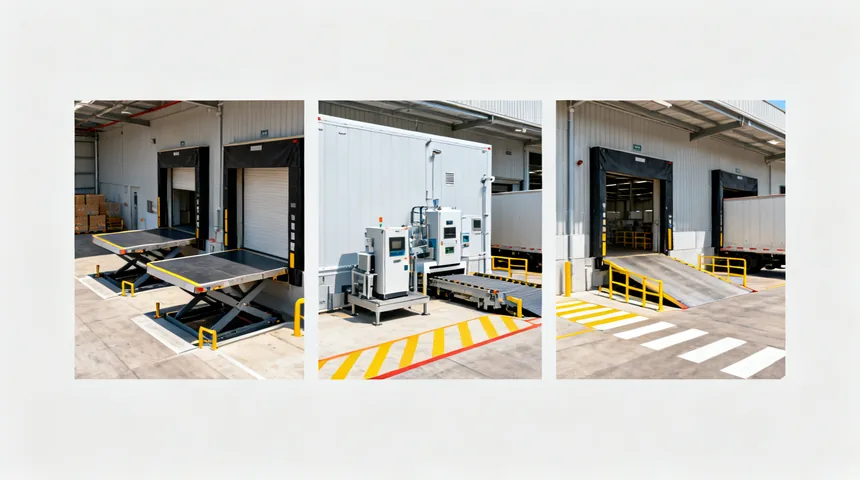
These profiles highlight common decision variables, not fixed specifications. Replace them with measured site conditions and an agreed design case.
Volatile SKU depth and compressed carrier windows. Fast staging with documented buffer occupancy.
Scheduled waves and mixed load units. Hygiene and washdown adjacency matter.
Temperature-zoned transfer. Limit open time and define safe fault response.
Line-critical arrivals. Residual capacity and fallback bay rules are mandatory.
Shared bays. Interlock and spare ownership must be named per contract.
Map the physical and control sequence from arrival through departure. Hidden dependencies become visible before they turn into installation changes.
A bay may appear adequate under average flow and still fail during a concentrated peak or abnormal state. Review what happens when the expected sequence breaks, who decides the next step and which safeguards must remain active.
Do not treat manual override as a throughput feature. Its permitted use, authorization, indicators and restoration steps need their own risk review and operating procedure.
State rated load in kg with load center and dimensions; usable platform size in mm; trailer bed-height range; cycles per hour; peak-window duration; buffer occupancy; and the fault cases exercised. Without those conditions, two throughput figures are not comparable.
Hold transfer, confirm geometry and use only an approved alternative rather than improvising a bridge condition.
Stop elevation, remeasure overhang and residual capacity before returning the table to live staging.
Document supported positions, emergency lowering, stored energy and restart authorization for each equipment boundary.
Use a defined reassignment and buffer plan, then measure the system effect instead of bypassing lift controls.
A tightly sequenced design can support a high defined peak when trailer arrivals, staffing and downstream space remain inside the design case. The trade-off is greater sensitivity to a blocked bay or offline lift.
Extra bay flexibility, alternate routes and recovery buffers can stabilize output during disturbances. They may require more footprint or capital and can reduce the headline rate under ideal conditions.
Fixed installs favor repeatable staging height and pit or floor anchoring. Relocation cost rises when the operating profile changes.
Mobility supports shifting pick faces and temporary peaks. Floor quality, caster duty and parking discipline become first-order constraints.
Share arrival timing, trailer range, load units, handling paths, control interfaces and the exceptions that matter most. A bounded profile is more useful than a generic industry label.